At a glance
Gaffer tape is a matte, cloth-backed tape designed for temporary production work and cleaner removal. Cloth tape is a general category that includes gaffer tape plus medical, bookbinding, and utility tapes. Check the coating and adhesive before substituting one for the other.
- Every gaffer tape is a cloth tape; not every cloth tape is gaffer tape.
- The matte film and lower-tack adhesive are what make gaffer tape useful on set.
- A cheap cloth tape can look right and still leave residue or glare.
The short answer
If you need a tape for a temporary cable path, a floor mark, or a label on a finished surface, gaffer tape is the more specific tool. If you need a cloth tape for a medical task, bookbinding, or a rough utility job, use the product made for that task. The words are not interchangeable even though the backing is similar.
The confusion comes from the fact that gaffer tape is a cloth tape. The category is real. The problem is that the category is too broad to predict how a particular roll will behave.
What makes gaffer tape different
Three features do most of the work. The first is the matte film laminated to the cloth. It cuts reflection, gives the tape a writable surface, and helps it tear cleanly. The second is the adhesive, which is usually formulated for temporary bonding and cleaner release. The third is the quality control behind the roll: consistent width, clean edges, and a backing that does not delaminate when you tear it.
Those features cost money. A cheap cloth tape may skip the matte film, use a more aggressive adhesive, or use a backing that stretches instead of tearing. It may still be black and cloth-backed. It may still work for a rough job. It is not the same product.
What cloth tape can mean
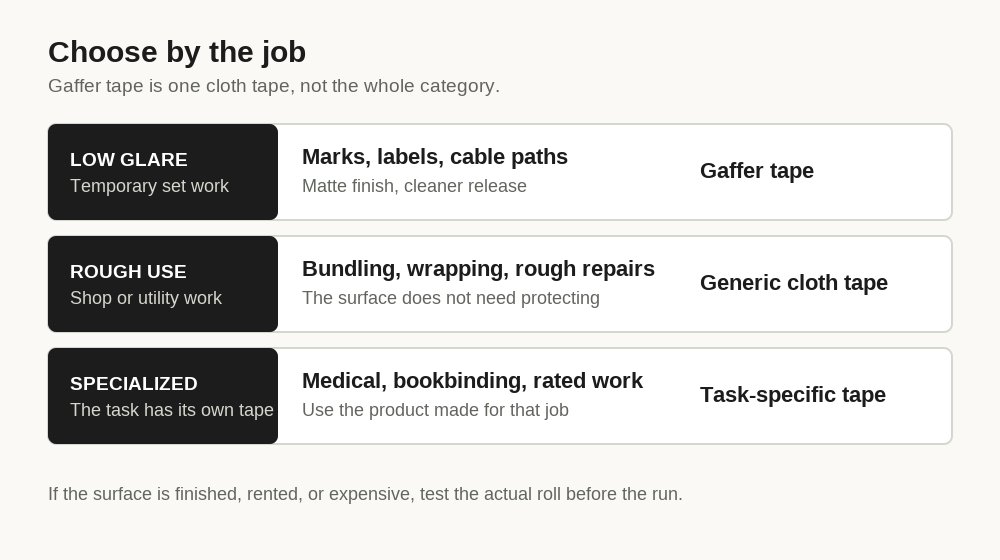
Cloth tape appears in several unrelated aisles. Medical cloth tape is designed for skin and should not be replaced with a hardware tape. Bookbinding cloth tape is designed for spines and hinges. Hockey tape is a cloth tape with a specific adhesive and finish. Duct tape uses a cloth scrim under a polyethylene film. Gaffer tape is the production tape most people mean when they say cloth tape on a set.
Read the product description instead of the category. If the label does not state the backing, adhesive, and intended use, assume you do not know enough to put it on a finished surface.
Adhesive and residue
Gaffer tape usually uses a rubber-based adhesive with a lower tack than duct tape, or an acrylic adhesive on some products. The goal is a bond that holds during the job and releases without taking the surface with it. That is a design goal, not a guarantee. Heat, time, and surface condition can override it.
A generic cloth tape may use a high-tack adhesive intended for a permanent or semi-permanent bond. On a painted floor or a rental case, that can be the wrong behavior. The tape may hold beautifully and remove badly.
If residue is the deciding factor, test the actual roll on the actual surface. A product that calls itself residue-free is telling you about a test condition, not your floor.

Strength and conformability
Gaffer tape is not a high-strength structural tape. It is strong enough to hold a cable flat and conform to a corner, but it is not a replacement for a clamp, a strap, or a rated fastener. Its value is in temporary control, not load bearing.
Cloth tape can be stronger or weaker depending on the backing and adhesive. Some cloth tapes are designed for heavy bundling. Some are thin and conformable. Do not assume that a thicker cloth tape is better for a delicate surface. A stronger bond can remove more finish when it lets go.
How to tell them apart in the hand
Tear a short piece across the width. A gaffer tape should tear cleanly with a modest pull and leave a relatively straight edge. A generic cloth tape may stretch, fray, or need a knife. The tear is not a laboratory test, but it tells you whether the backing was chosen for hand work.
Look at the surface under a light. A matte gaffer tape should not throw a hard reflection. A cheap cloth tape may look shiny or uneven. Check the edge of the roll. A clean, consistent edge is easier to line up on a cable or a mark. A ragged edge catches on itself and collects dirt.
Check the adhesive side. If it feels greasy or the roll is oozing at the edges, the tape may have been stored too warm. A soft roll can still work, but it is more likely to leave residue. Store tape away from heat and test any roll that has been in a hot vehicle.
Where the difference shows up
On a black stage floor, a cheap glossy cloth tape may catch a light and show in a wide shot. A matte gaffer tape is less likely to do that. On a rented cable, a high-tack cloth tape may leave a sticky ring that collects dust. A gaffer tape is more likely to come off cleanly, though the jacket material still matters.
On a short job with a tolerant surface, the difference may be invisible. On a long job, a hot location, or a finished surface, it becomes obvious. The more expensive tape is often the cheaper choice when removal time is included.
Where a generic cloth tape is the better buy
If the job is rough bundling in a shop, wrapping a handle, or a temporary repair on a surface you do not care about, a general cloth tape may be enough. Paying for a matte production tape in that setting is not necessary. The mistake is the reverse: using the cheap roll on a finished stage floor because it is the roll that is already open.
Keep the two rolls separate. A black roll with no label is an anonymous product. If the cheap tape ends up in the on-set kit, someone will eventually put it on a surface that needed the better tape. Mark the core and store the utility tape with the utility tools.
Width and color change the job
Width changes the job. One-inch tape is easier to wrap around a cable and to place on a narrow mark. Two-inch tape covers more surface and is the common size for cable paths and general set work. Three-inch tape is useful for wide coverage but harder to control on a small label.
Color is functional. Black disappears on dark surfaces and in shadows. White shows up on dark floors and accepts ink well. Bright colors are for marks that need to be found quickly. A matte finish matters more than the color for camera glare, but the color still decides whether the tape reads as a mark or disappears.
A buying checklist
Look for the backing, the coating, the adhesive, and the intended use. Check the width and the color. Check whether the maker describes the tape as removable or residue-free, and read the conditions attached to that claim. If the product is for a rated job, look for the rating.
Buy one roll and test it before you buy a case. Write the product name on the core. Store the roll away from heat and dirt. A clean roll of the right tape is easier to use than a bargain roll that has been in a hot trunk.
| Question | Why it matters |
|---|---|
| What is the backing? | Cloth, coated cloth, and cloth scrim behave differently |
| Is the surface matte? | Glare can show on camera even when the tape is black |
| What is the adhesive? | Tack and release decide the cleanup |
| Is it rated for the job? | A temporary tape is not a substitute for a rated product |
| How long will it stay? | Dwell time changes the removal result |
Common questions
Is gaffer tape a cloth tape?
Yes. Gaffer tape uses a cloth backing, usually with a matte film coating and a pressure-sensitive adhesive.
Can I use cloth tape instead of gaffer tape?
Only if the product is designed for the same job. A medical or bookbinding cloth tape is not a substitute for a production tape, and a high-tack utility cloth tape may damage a finished surface.
Is gaffer tape waterproof?
Most gaffer tape is not intended for outdoor or wet use. Use a product rated for the conditions, and do not treat any temporary tape as a permanent seal.
How can I tell gaffer tape from other cloth tape?
Look for a matte surface, a clean tear across the roll, and a product description that names the backing and adhesive. A glossy, hard-to-tear cloth tape is probably a different product.
Is expensive gaffer tape worth it?
It depends on the surface and the removal. On a finished floor, a rented prop, or a cable jacket, the cleaner release can save more time than the price difference. On rough utility work, a cheaper cloth tape may be enough.
Sources & further reading
- Pro Tapes: gaffer tape construction and applications ↗
General guidance on gaffer tape; specifications on that page apply to Pro Gaff, not TufGaff.
- TufGaff: roll sizes and product listing ↗
Check the listing for the selected size, color, price, and availability.
Stock the kit.
2-inch matte cloth tape. Black in 30 or 55 yards; white in 55 yards.