
At a glance
Add the length of each planned strip, include labels and marks, allow for changes and offcuts, then divide by the usable length of one roll and round up. Keep a separate reserve when running out would interrupt the job.
- 55 yards = 165 feet; 30 yards = 90 feet.
- Multiply by the number of tape strips, not automatically by the number of cables.
- A quantity estimate does not determine whether a cable route needs a protector.
Separate long runs from small pieces
Make three lines in the plan: continuous runs, labels, and marks. Continuous runs usually dominate the length; small pieces dominate the counting. Keeping them separate makes the estimate easy to revise when a stage plot or input list changes.
For continuous runs, measure the intended route around the room. Include corners and transitions. Record how many strips of tape the chosen method requires. A bundle of three cables under one continuous cover is one strip for the length calculation; a method with two separate edge strips uses two.
Count short pieces by their actual cutting length. Twenty labels at six inches each use ten feet of tape before offcuts. Twenty L-shaped marks made from two three-inch pieces also use ten feet. Writing down those assumptions is more useful than adding an unexplained extra roll.
Put everything into one unit
Choose feet, yards, or meters for the whole calculation. Mixing a 55-yard roll with cable lengths written in feet is a common way to overestimate or underestimate by a factor of three.
A yard is three feet, so a 55-yard roll contains 165 feet and a 30-yard roll contains 90 feet. For metric planning, those nominal lengths convert to 50.292 meters and 27.432 meters. Use the length printed for the actual product rather than treating a rounded marketing conversion as exact.
The calculator below works in feet or meters and compares both roll lengths. It estimates length only. It does not decide the tape width, the installation method, or the protection needed for a crossing.
| Roll length | Feet | Meters, converted |
|---|---|---|
| 30 yd | 90 ft | 27.432 m |
| 55 yd | 165 ft | 50.292 m |
| Difference | 75 ft | 22.860 m |
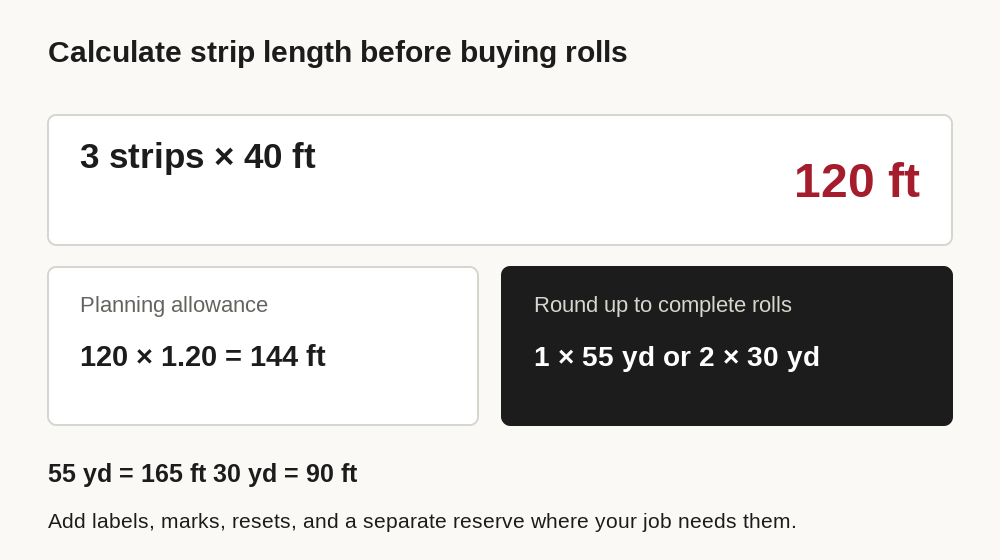
Worked example: three 40-foot strips
Suppose the plan calls for three separate strips, each forty feet long. The measured tape length is 3 × 40 = 120 feet. Add a planning allowance of 20 percent for offcuts and small changes: 120 × 1.20 = 144 feet.
Divide 144 feet by 165 feet per 55-yard roll. The answer is about 0.87, so round up to one roll. Divide the same 144 feet by 90 feet per 30-yard roll. The answer is 1.6, so round up to two rolls.
That comparison describes this example, not a universal allowance. If you expect repeated resets, several departments borrowing tape, or an uncertain route, write those needs into the plan. A longer roll can reduce changes during a long run; a shorter roll may still be easier to carry for a small task.
Now add labels and stage marks
Take that same example and add fifteen six-inch labels. Fifteen times six is ninety inches, or 7.5 feet. Add twenty L marks using two three-inch pieces each: 20 × 2 × 3 inches = 120 inches, or ten feet.
The measured total is now 120 + 7.5 + 10 = 137.5 feet. With the same 20-percent allowance it becomes 165 feet, exactly the nominal length of one 55-yard roll. On paper, the rounded roll count is still one. In a real kit, that leaves no additional reserve beyond the allowance you already counted.
This is where the person responsible for the job makes a practical decision. If getting another roll would take half an hour, carry a reserve. If stock is available in the same room, the department may choose a smaller local kit. Keep that reserve decision visible instead of changing the arithmetic to justify it.

Account for resets and shared stock
A mark that remains for three rehearsal days is not three new applications. A temporary camera setup rebuilt each morning might be. Count installations and removals rather than simply multiplying the first day's quantity by the number of calendar days.
If several crews share one roll, assign a stock location and a person who can issue replacements. A roll that is somewhere on the truck is less useful than an identified spare at the operating area. Include labels, tape used in packing, and the last-minute requests that reliably occur on your particular jobs.
For recurring work, record the actual rolls opened and the useful partial rolls returned. After several similar events, those observations can replace a broad allowance with a better estimate. Do not present an unmeasured percentage as a universal production standard.
Choose roll size and color after estimating the task
A long continuous route benefits from fewer interruptions. Small label and spike-mark work may fit comfortably within a compact roll. Choose between 30 and 55 yards with that work pattern in mind, then check the selected color and size on the listing.
Separate colors in the estimate if they have different jobs. A white labeling roll should not be counted as the entire reserve for a black camera-visible floor run unless that substitution is acceptable. Write down both quantities, even if you ultimately buy them together.
For bulk planning, convert the required roll count to the actual case pack and round up again. TufGaff's bulk configurator uses twenty-four 55-yard rolls per case. An estimate of twenty-five rolls therefore does not become one case simply because it is close.
Use the estimate as a purchasing note
Save the measured length, cutting assumptions, allowance, roll length, and reserve in the job notes. A purchasing request that says "two rolls" is hard to revise intelligently. A request that explains the routes and expected resets can be checked by another crew member.
Before ordering, confirm that the venue permits the planned tape and that any required cable protectors are a separate item. Buying more tape does not solve a method that is unsuitable for the route.
After strike, compare the estimate with what was used. Keep useful partial rolls identified and clean. The next estimate should improve because the crew learned something specific about the job, not because the calculator displayed more decimal places.
Planning tool
Estimate your rolls
Enter continuous strips below. Add short labels and marks separately to your purchasing plan.
144 ftIncluding 20% allowance
- 55-yard rolls
- 1
- 30-yard rolls
- 2
Common questions
Is a 55-yard roll almost twice a 30-yard roll?
It is 1.83 times the nominal length, or 75 feet longer. Whether it replaces two shorter rolls depends on your strip lengths, offcuts, color requirements, and reserve.
Is 20 percent the correct allowance for every job?
No. It is an example planning input, not a standard. Use actual experience, uncertainty, resets, and access to spare stock to choose the allowance for your job.
Sources & further reading
- TufGaff: roll sizes and product listing ↗
Check the listing for the selected size, color, price, and availability.
Stock the kit.
2-inch matte cloth tape. Black in 30 or 55 yards; white in 55 yards.