At a glance
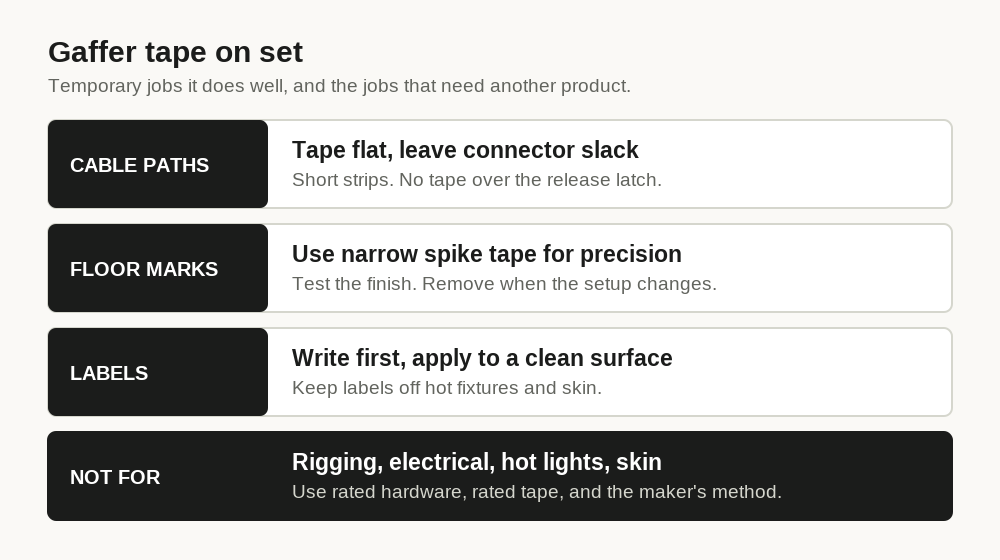
Use gaffer tape for cable paths, floor marks, labels, and other short-term set work on compatible surfaces. Do not use it for rigging, electrical repair, hot lights, skin, or anything that needs a rated fastener.
- The matte film on the cloth backing is what keeps reflections down and makes the tape easy to tear.
- A cable path needs enough tape to stay put and few enough pieces to come up quickly.
- Test the surface and set a removal time before the tape goes down.
The name comes from the crew, not the adhesive
On a film crew, the gaffer is the head electrician. The tape took the department's name because it was useful for dressing cables, marking positions, and holding small things during a shoot. It was never a single-purpose product, and that is part of the confusion. Today camera, grip, art, sound, and locations all keep a roll within reach.
The name does not tell you what the tape can hold. A roll of gaffer tape is a cloth-backed pressure-sensitive tape with a matte finish, usually sold in 1-inch, 2-inch, and sometimes 3-inch widths. The width, adhesive, and backing vary by maker. Two black rolls can behave differently on the same painted floor.
Treat the label as a starting point. The useful questions are what surface it will touch, how long it will stay, and who has to remove it.
What the film in gaffer tape actually is
A search for gaffer tape film can mean two things. It can mean tape for film production, which is the subject of most of this guide. It can also mean the film layer on the tape itself. Both are worth understanding.
Most gaffer tape starts with a woven cloth backing. A thin polyethylene film is laminated to the cloth, and the adhesive is applied to the other side. The film gives the tape its matte surface, makes it writable, and helps it tear across the roll instead of stretching into a string. The cloth gives it strength and conformability. The adhesive decides how it sticks and how it lets go.
That film is not cinema film, and it is not a release liner. It is part of the tape. If the surface looks shiny or the tape feels slick, you may be looking at a cloth tape with a different coating, not a matte gaffer tape.
The construction also explains a limitation. A matte film reduces glare from a light or a camera reflection, but it does not make the tape invisible. A two-inch black strip on a light floor is still a two-inch black strip. Check the patch from the camera position, not from standing height.
Cable paths are the main job
The most common set use is keeping cable out of the path of feet, carts, and dollies. Tape the cable flat, keep the run tidy, and leave enough slack at each connector that the plug is not taking the strain. Do not tape over the connector body or the release latch. If someone needs to unplug in a hurry, the tape should not be the obstacle.
On a smooth floor, short pieces every couple of feet are usually enough to keep a light cable in place. On carpet or a rough stage, you may need more contact or a different method. For a run that crosses a walkway, a vehicle path, or a heavy cart route, use a cable protector or reroute the cable. Gaffer tape is not a ramp and it is not a substitute for a proper cable cover.
Avoid wrapping a cable fully around the circumference unless you have a reason. A full wrap uses more tape, takes longer to remove, and puts adhesive against the jacket. A short strip across the cable, pressed down at both ends, is easier to lift and easier to inspect. If the cable must be secured to a vertical surface, use a method that does not rely on the jacket for support.
Keep power and audio separated where the production plan requires it. Tape does not solve an interference problem, and a neat-looking run can still be the wrong route.
Marks that read on camera without becoming props
Actors and camera operators need repeatable positions. Gaffer tape can mark them, but a two-inch roll is often too wide for a precise mark. Spike tape, which is narrower and usually comes in bright colors, is the more common choice for a taped cross or a small L. Save the wide roll for cable work and labels.
Choose a color that reads against the floor under the actual lighting. White disappears on a pale cyc; black disappears on a dark stage. Fluorescent pink or green may be easy to see but may also appear in a wide shot. Put the mark where the camera will not frame it, or accept that it will be visible and plan around it.
Test the mark on the same floor finish before the shoot. A painted stage floor, a finished wood floor, and a vinyl dance floor can respond differently to the same adhesive. If the floor is rented or historic, get permission and use the removal method the owner approves.
Remove marks when the setup changes. A floor covered in old crosses is harder to read than a floor with three current marks. It also gives the crew more adhesive to remove at the end of the day.

Labels and small holds
Gaffer tape is writable with a marker, which makes it useful for labeling cable ends, cases, stands, and positions. Write the label before you stick it down. Let the ink dry, then press the tape onto a clean, dry surface. A label applied over dust or oil is likely to lift at the edges.
Keep labels off hot surfaces. A light housing, a lamp cable near the head, or a heater can soften the adhesive and make the tape slide or leave a mess. Use the fixture maker's approved method for marking equipment. If the surface is too hot to touch, it is too hot for a temporary tape label.
For talent, costumes, and delicate fabrics, use paper tape or the wardrobe department's approved method. Gaffer tape is too aggressive for skin and can damage fabric, paint, or a rental costume. The fact that a tape is made for film sets does not make it safe for every material on a film set.
Where gaffer tape is the wrong tool
Gaffer tape is temporary by design. That makes it a poor choice for jobs that need a permanent or rated connection. The table below is a starting point, not a product specification. When a job has a code, a manufacturer's instruction, or a safety requirement, follow that instead of the nearest roll.
The reverse mistake is also common. Do not use duct tape for every job just because it is stronger. A high-tack tape that is difficult to remove can turn a five-minute strike into an hour of cleaning. Match the tape to the surface and the removal plan, not to the color of the roll.
| Job | Better choice | Why |
|---|---|---|
| Electrical insulation or a damaged cable | Rated electrical tape and a qualified repair | Gaffer tape has no insulating rating |
| Rigging a light or an overhead object | Rated hardware and a qualified rigger | Tape is not a load-bearing fastener |
| A hot light or fixture | High-temperature tape approved by the fixture maker | Standard gaffer adhesive can soften |
| Skin or a costume | Paper tape or a wardrobe-approved method | Gaffer adhesive is too aggressive |
| A dance-floor seam | The floor manufacturer's seam tape | The floor system specifies its own tape |
| A long outdoor repair | An outdoor-rated repair product | Sun, water, and temperature defeat temporary tape |
| Sealing a duct or a weather gap | The specified sealant or foil tape | Gaffer tape is not a seal |
Test the surface, then remove on time
Pick an inconspicuous spot on the same material and finish as the real application. Clean it, apply a short strip with the pressure you expect to use, and leave it for a representative time. A one-minute test in a cool room does not predict an overnight run under a hot light.
Remove the test strip slowly and look at both the surface and the adhesive side. If paint, coating, or fibers lift, change the method. Less tape or a shorter dwell may help, but the better answer may be a different tape or no tape at all.
At strike, remove the tape before the room heats up or the schedule runs out. Peel at a low angle and support the surface where you can. If a strip resists, stop and use the removal method approved for that material. A faster pull is not a safer pull.
Common questions
Is gaffer tape safe to use on a camera?
Short-term, on a compatible surface, yes, but test first. Avoid rubberized coatings, printed markings, vents, and any area the maker says not to cover. Tape can leave residue or lift a finish, and a camera is an expensive place to learn that.
Why is it called gaffer tape?
It is named after the gaffer, the head electrician on a film or television crew. The tape became a general set consumable, but the name came from one department.
Can gaffer tape hold a light?
No. Use rated mounting hardware and a qualified person. Tape is not a substitute for a clamp, a stand, a safety cable, or a rigging plan.
Sources & further reading
- Pro Tapes: gaffer tape construction and applications ↗
General guidance on gaffer tape; specifications on that page apply to Pro Gaff, not TufGaff.
- TufGaff: roll sizes and product listing ↗
Check the listing for the selected size, color, price, and availability.
Stock the kit.
2-inch matte cloth tape. Black in 30 or 55 yards; white in 55 yards.